Virginia Tech's Lab-in-a-Box showcased at national department heads meeting
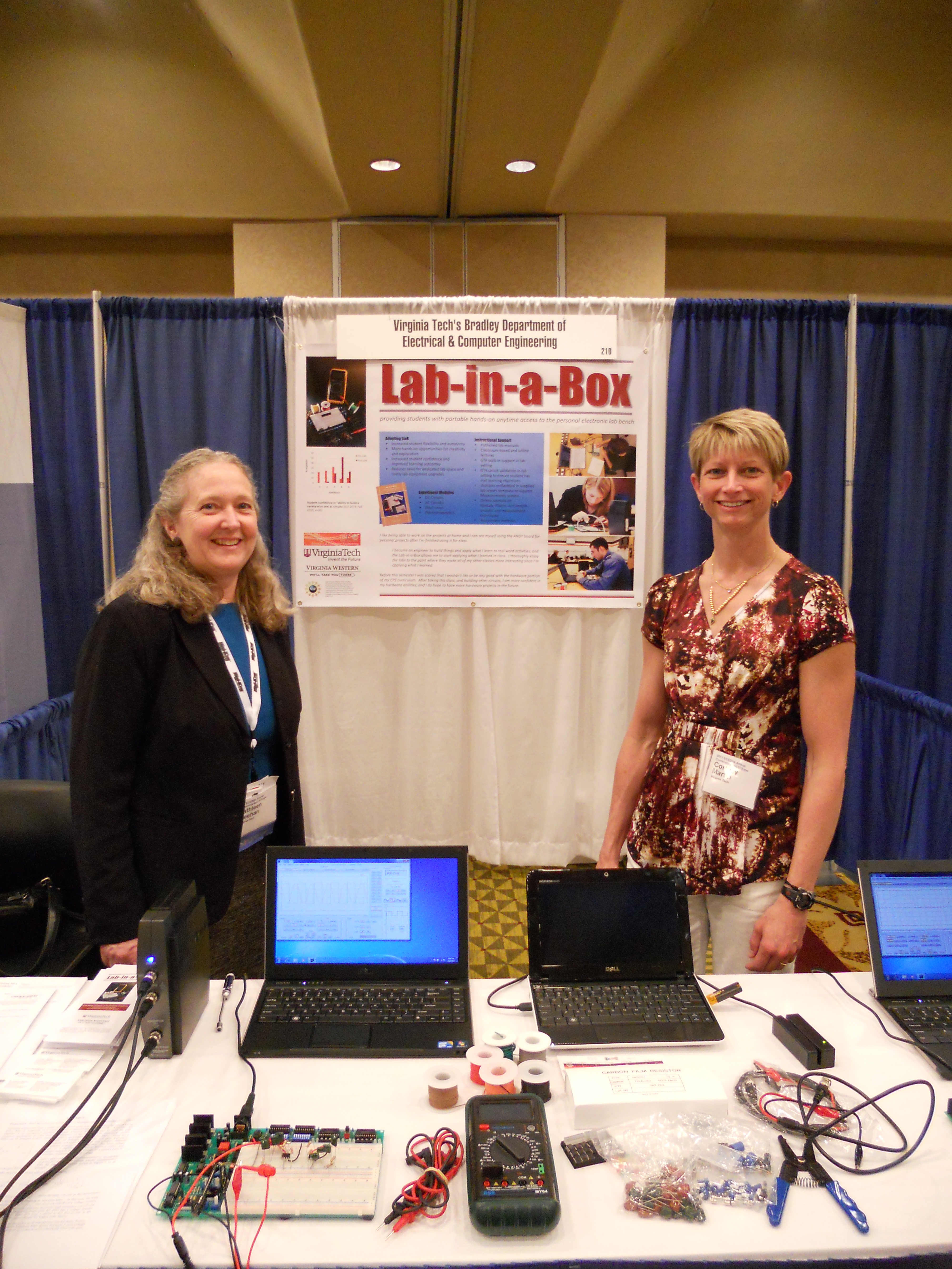
College students using a hands-on electronic learning and exploration tool called Lab-in-a-Box have reported a significant positive impact on their confidence and ability to learn electrical engineering.
Developed at Virginia Tech, the innovative Lab-in-a-Box kit and curriculum were showcased at the 2011 Electrical and Computer Engineering Department Heads Association Meeting, held recently in Phoenix, Ariz.
“Lab-in-a-Box provides students with portable hands-on anytime access to their personal electronic lab bench. It includes a universal serial bus powered oscilloscope, powered analog/digital breadboard, digital multimeter, and a variety of components,” Kathleen Meehan, associate professor of electrical and computer engineering at Virginia Tech, explained.
At present, Virginia Tech incorporates Lab-in-a-Box within four electrical and computer engineering courses, two of which are taken by mechanical engineering undergraduates and the other two are taken by the electrical and computer engineering undergraduates. Experiments for several other courses are under development.
The accompanying lab manual, written by Robert Hendricks, professor of materials science and engineering at Virginia Tech, and Meehan, is set for a fourth edition that will be published later this year.
Meehan and her colleagues, Hendricks, Peter Doolittle of Virginia Tech’s Center for Instructional Development and Education Research, and Richard L. Clark Jr. of Virginia Western Community College, serve as investigators on the project that has received support from the National Science Foundation’s Course, Curriculum, and Laboratory Improvement Phase II program, which builds upon its department-level reform of undergraduate education project, as well as from the Bradley Department of Electrical and Computer Engineering. Cortney Martin, in the same office as Doolittle, is overseeing project assessment.
They are encouraging other departments across the country to adopt this curricular approach that fosters hands-on experience using this portable and affordable kit.
Meehan oversees the curriculum development and course expansions while Martin is responsible for the project assessment. Martin said data has shown that “Lab-in-a-Box significantly boosted student confidence and students appreciate the flexibility and portability of this learning environment.”