University faculty and students create an exhibition for the Taubman Museum of Art
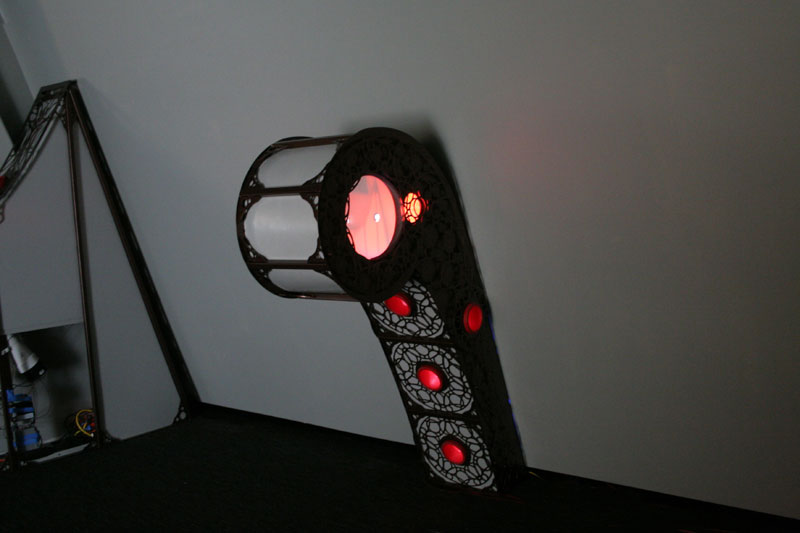
Faculty in the Virginia Tech School of Visual Arts, in collaboration with the university's departments of computer science, music, and theatre arts, have created an exhibition —"Revo-oveR"— for the Taubman Museum of Art. It will premiere on Friday, Nov. 7 at a gala on the eve of the museum's grand opening.
Over the last three years, a group of faculty and students at Virginia Tech -- known collectively as the Digital Arts Research Collective -- has been working to create and install this original piece of multimedia art for the long-anticipated opening of Roanoke’s Taubman Museum of Art.
The exhibition is a presentation of new media; in this case, new media refers to art that engages multiple senses and encourages interactivity. “Revo-oveR” uses visual and aural information in an effort to create an interaction -- a social dialog that investigates and synergizes elements of gesture, touch, sight, and sound -- between viewers and the work.
The works within the installation suggest a human interconnectedness and provide a playful interaction between art, design, technology, and the museum visitor. “Revo-oveR” sends virtual entities into constant motion across free-form projection screens. These entities react to the presence of visitors within the installation. It moves and makes sounds as the gestures and voices of the audience are processed by elements of the exhibit’s system. Abstract data and human creative thought come together in a sensory environment that aims to stimulate curiosity and interactivity with the exhibition.
As School of Visual Arts Director and Creative Technologies in the Arts and Design Director Truman Capone has facilitated this project in collaboration with the Art Museum of Western Virginia. The project was accomplished through the team collaboration and dedication of the following faculty and student artists, technologists, and designers, each of whom offered specific skills and specialties.
Participating creative artists, technologists, and designers were
- Carol Burch-Brown, professor, School of Visual Arts;
- Ivica Ico Bukvic, assistant professor, Department of Music in the College of Liberal Arts and Human Sciences;
- Steve Harrison, research faculty, Department of Computer Science in the College of Engineering;
- Simone Paterson, assistant professor, School of Visual Arts;
- Joy Rosenthal, instructor, School of Visual Arts;
- Eric Standley, assistant professor, School of Visual Arts; and
- Dane Webster, assistant professor, School of Visual Arts.
Research assistants were
- Sabrina Kilian, third-year student majoring in computer science in the College of Engineering from Clifton Forge, Va.;
- Bryan Lawson, fourth-year student majoring in visual communications design in the School of Visual Arts from Rural Retreat, Va.;
- Chris Oehring, second-year student majoring in studio arts in the School of Visual Arts from Charlotte, N.C.;
- Amber Erbschloe, fourth-year student majoring in studio arts from Newport, Va.; and
- Bob Beaton, a doctoral student in computer science in the College of Engineering from Blacksburg, Va.
Other project contributors include
- Michael Anthony Williams, instructor, Department of Theatre Arts in the School of Performing Arts and Theatre and
- Ann Kilkelly, professor, Center for Interdisciplinary Studies in the College of Liberal Arts and Human Sciences.